

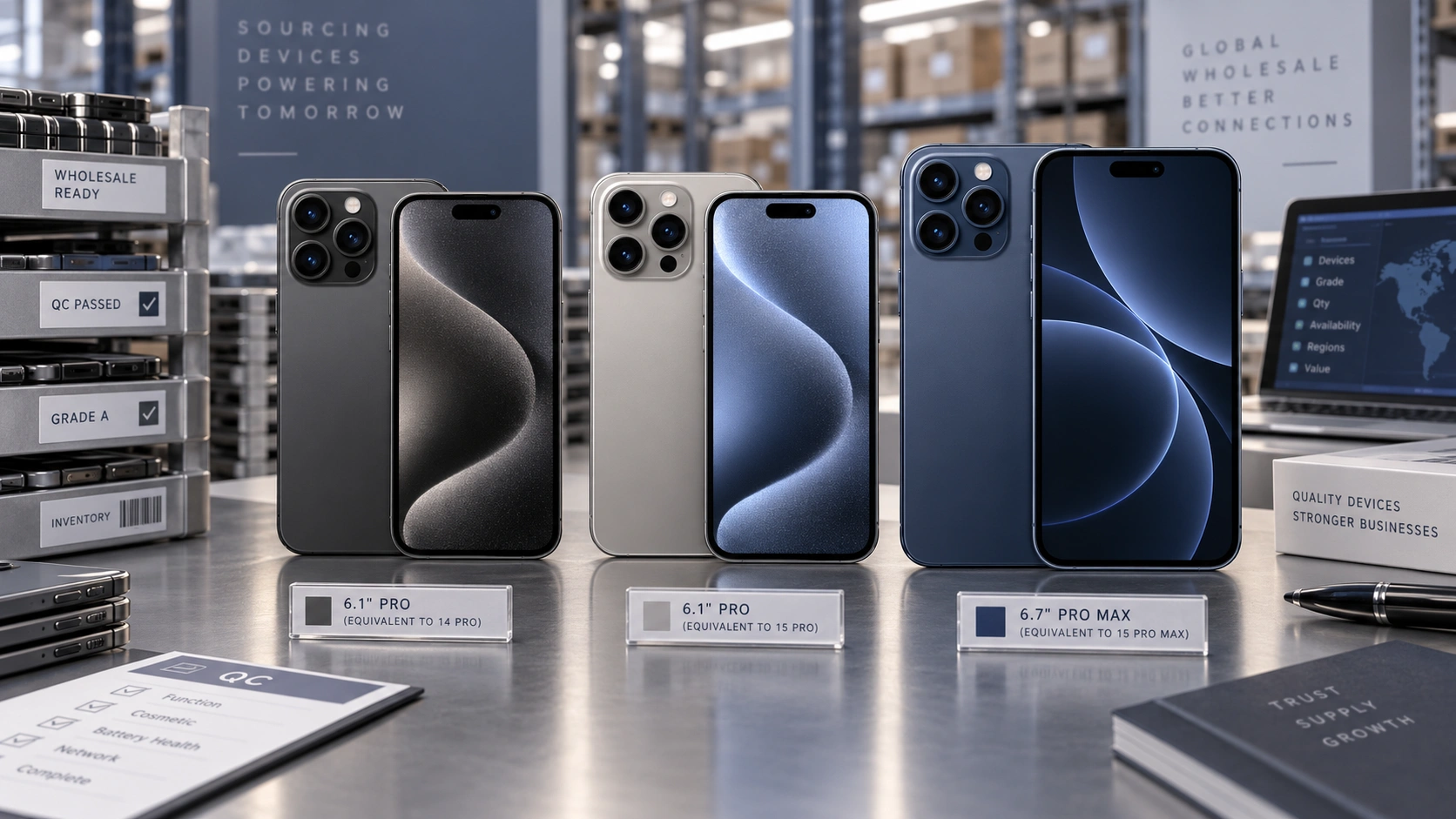
For B2B buyers, choosing between the iPhone 14 Pro, iPhone 15 Pro and iPhone 15 Pro Max is not simply a question of buying the newest model.
The three devices sit at different positions in the used iPhone market, but model generation alone does not determine whether a wholesale batch is commercially attractive.
A professional buying decision should consider model, storage, regional version, SIM configuration, grade, battery condition, network status, quantity and the destination resale market.
For buyers sourcing used iPhones in bulk, the more useful question is: which specification fits my resale market, and what is the true commercial value of the batch?
The Short Answer
The iPhone 14 Pro can provide access to the Pro category at an earlier-generation market position, making it relevant for buyers balancing specification and acquisition cost.
The iPhone 15 Pro adds USB-C, the A17 Pro chip and Apple Intelligence support while retaining the 6.1-inch Pro form factor.
The iPhone 15 Pro Max moves further into the premium segment with a 6.7-inch display, 256GB minimum storage and a 5x telephoto camera.
For wholesale buyers, however, these hardware differences are only the starting point. A well-matched iPhone 14 Pro batch can make more commercial sense than a poorly matched iPhone 15 Pro batch if the latter has the wrong regional version, unsuitable storage mix, inconsistent grading or battery specifications that do not fit the buyer’s resale channel.
iPhone 14 Pro vs 15 Pro vs 15 Pro Max: Key B2B Differences
| Specification | iPhone 14 Pro | iPhone 15 Pro | iPhone 15 Pro Max |
|---|---|---|---|
| Introduced | 2022 | 2023 | 2023 |
| Display | 6.1-inch | 6.1-inch | 6.7-inch |
| Chip | A16 Bionic | A17 Pro | A17 Pro |
| Frame | Stainless steel | Titanium | Titanium |
| Storage | 128GB / 256GB / 512GB / 1TB | 128GB / 256GB / 512GB / 1TB | 256GB / 512GB / 1TB |
| Connector | Lightning | USB-C | USB-C |
| Apple Intelligence | Not supported | Supported* | Supported* |
| U.S. SIM configuration | eSIM only | eSIM only | eSIM only |
| Physical SIM availability | Depends on regional version | Depends on regional version | Depends on regional version |
| Wholesale position | Earlier Pro generation | Newer 6.1-inch Pro | Premium large-screen Pro Max |
*Apple Intelligence availability can depend on software version, language and region.
These differences matter, but wholesale buyers should avoid treating the table as a simple ranking. A device that is technically newer can still be commercially less suitable if its configuration does not match the destination market.
1. Start With Market Fit, Not Model Generation
iPhone 14 Pro
The iPhone 14 Pro remains part of the modern Pro design generation, with Dynamic Island, a 48MP main camera, ProMotion and the A16 Bionic chip. As the oldest of the three models in this comparison, it can give buyers another entry point into the Pro category without requiring them to purchase a newer 15-series device.
For a wholesale buyer, the commercial question is therefore not whether the 14 Pro is “old.” The relevant questions are:
What is the current acquisition cost?
Which storage configurations are available?
What grades and battery specifications are available?
Which regional versions are included?
How quickly can the stock be resold in the destination market?
iPhone 15 Pro
The iPhone 15 Pro keeps the 6.1-inch format while moving to titanium, USB-C and the A17 Pro chip. It also belongs to Apple’s current Apple Intelligence-supported device range. For B2B buyers, this can help position the 15 Pro between earlier Pro inventory and larger, higher-value Pro Max stock.
iPhone 15 Pro Max
The iPhone 15 Pro Max has a 6.7-inch display and starts at 256GB rather than 128GB. It also includes the 5x telephoto camera introduced on this model.
From a wholesale perspective, the important difference is not simply that it has higher specifications. Because there is no 128GB configuration, the storage structure itself affects the value and capital requirement of a wholesale batch.
2. Purchase Price Does Not Equal True Wholesale Cost
One of the most common mistakes in used iPhone wholesale is comparing batches by unit price alone.
Consider two hypothetical offers:
Batch A
iPhone 14 Pro · 256GB · 100 units
Clear grade specification
Confirmed regional version
Battery requirement agreed
Consistent network status
Batch B
iPhone 15 Pro · 256GB · 100 units
Mixed cosmetic condition
Mixed regional versions
Battery condition varies
Additional sorting required
Batch B may be the newer product. That does not automatically make it the better commercial purchase.
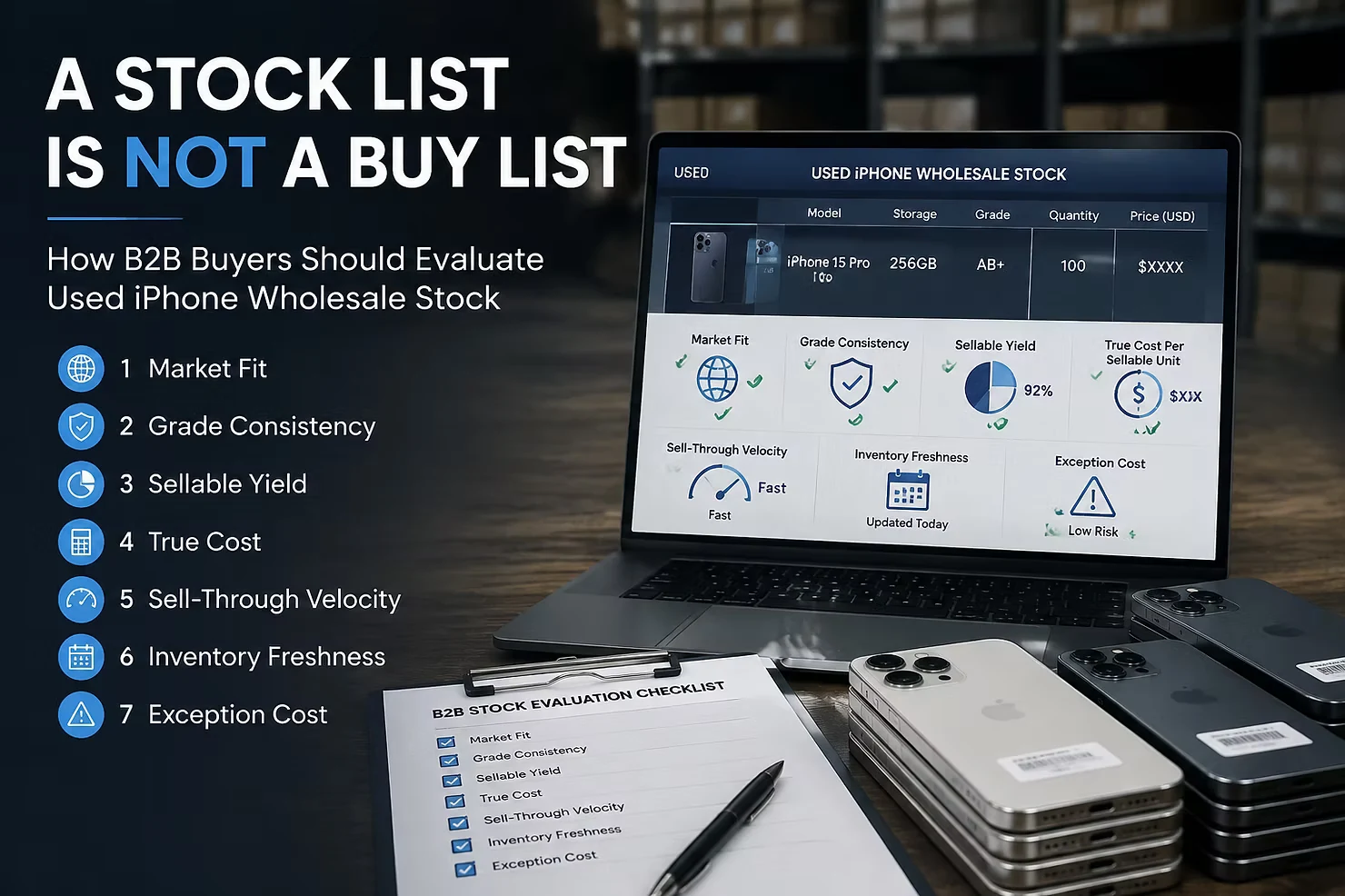
This is why professional buyers should compare market fit, grade consistency, sellable yield, true cost, sell-through speed and exception handling rather than relying on the quoted unit price alone. iPhonetree explains this approach in A Stock List Is Not a Buy List: How B2B Buyers Should Evaluate Used iPhone Wholesale Stock.
3. Storage Mix Can Change the Economics of the Order
Storage is sometimes treated as a secondary specification. In B2B purchasing, it can materially change both acquisition cost and resale positioning.
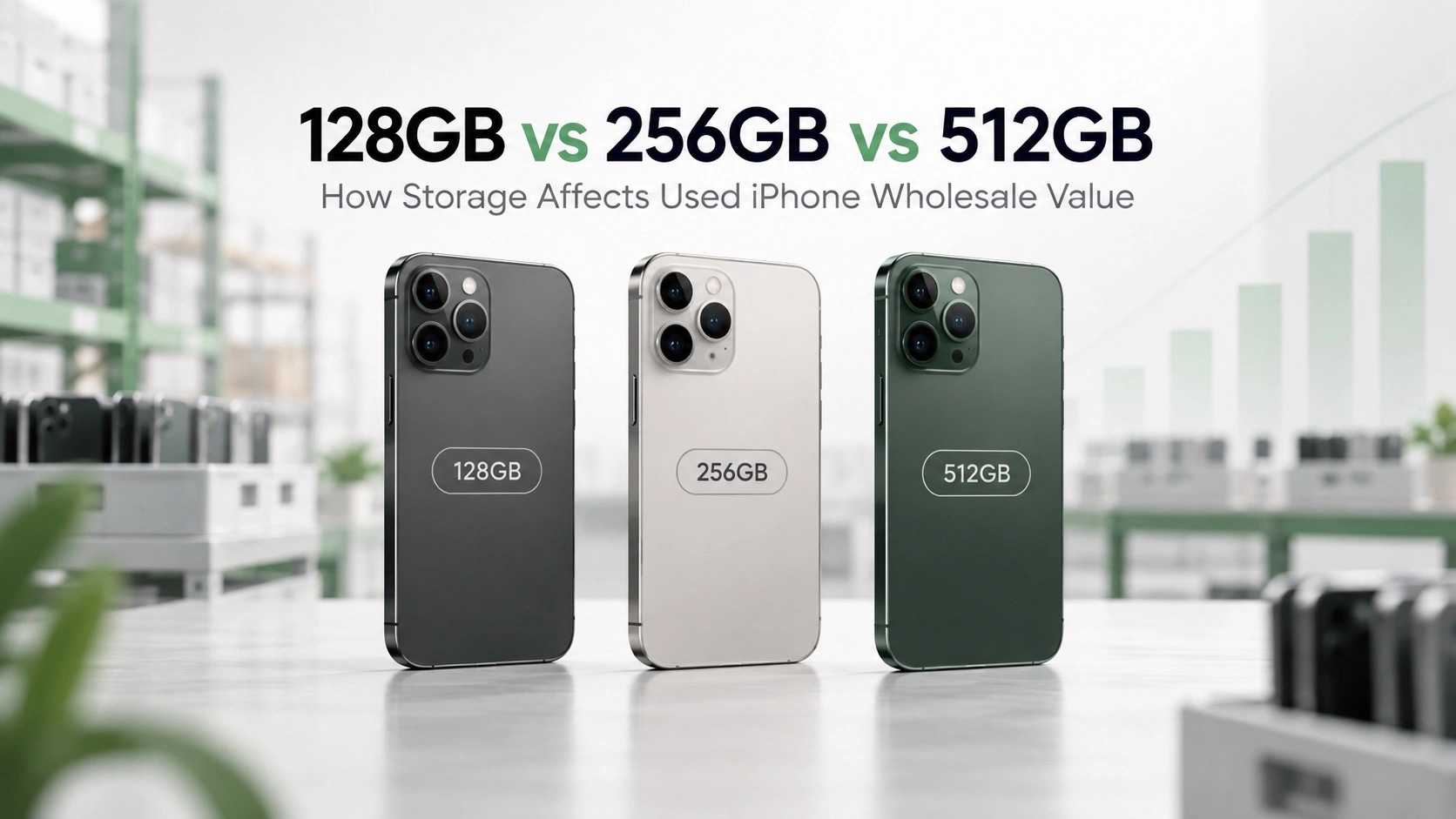
The iPhone 14 Pro and iPhone 15 Pro were offered in 128GB, 256GB, 512GB and 1TB configurations. The iPhone 15 Pro Max starts at 256GB and is also available in 512GB and 1TB. There is no 128GB iPhone 15 Pro Max.
That matters when comparing wholesale batches. For example, 100 units of iPhone 14 Pro 128GB and 100 units of iPhone 15 Pro Max 256GB should not be compared simply as “100 Pro-series iPhones.” The amount of capital tied up in the inventory, expected resale price, buyer profile and sell-through speed can all differ.
Professional buyers should therefore ask:
Is the batch single-storage or mixed-storage?
What percentage of the batch is in each capacity?
Which storage configurations move efficiently in the destination market?
Can the buyer resell higher-capacity stock without slowing inventory turnover?
The model name is only one part of the inventory structure.
4. Regional Version and SIM Configuration Can Matter More Than Generation
For international B2B buyers, regional specification is one of the most important differences to confirm before purchase.
U.S.-market iPhone 14 Pro, iPhone 15 Pro and iPhone 15 Pro Max devices do not have a physical SIM tray and use eSIM. Other regional versions can have different SIM configurations.
A professional buying request may need to state the model, storage, regional version, required SIM configuration, network status, agreed grade, battery requirement and quantity.
The same model can have different commercial suitability in different markets. A buyer whose customers require physical SIM support should confirm the regional version before comparing prices. A buyer whose resale channel is comfortable with eSIM-only devices may evaluate U.S. versions differently.
There is no universally superior regional version. There is only a regional specification that either fits or does not fit the destination market.
5. USB-C and Apple Intelligence Change the Product Position — Not the Entire Buying Decision
There are meaningful hardware differences between the 14 Pro and 15 Pro generation. The iPhone 14 Pro uses A16 Bionic, Lightning and a stainless-steel frame. The iPhone 15 Pro and 15 Pro Max move to A17 Pro, USB-C and titanium.
The 15 Pro series also supports Apple Intelligence, while the iPhone 14 Pro does not.
These differences can influence how a device is positioned downstream. However, a wholesale buyer should not evaluate used stock the same way a consumer technology review evaluates a new phone.
The better question is therefore not “Does the 15 Pro have more features?” but “Does my resale market value those differences enough to justify the acquisition cost and inventory exposure?”
6. Model Is Only the Starting Point: Grade, Battery and Condition Define the Batch
Two batches can contain exactly the same model and storage capacity while having very different commercial value.
For example:
Batch A
iPhone 15 Pro · 256GB
Clearly defined cosmetic grade
Battery requirement confirmed
Regional specification confirmed
Functional testing completed
Batch B
iPhone 15 Pro · 256GB
Mixed cosmetic condition
No defined battery requirement
Mixed regional versions
Additional testing required
Both may appear on a simple spreadsheet as “iPhone 15 Pro 256GB,” but they are not commercially equivalent.
Professional buyers should separate cosmetic grading from functional and commercial specifications. Screen condition, frame condition, back-glass condition and visible wear belong to cosmetic grading. Battery condition, network status, display and camera functions, charging, Face ID, connectivity, regional version and SIM configuration should be confirmed separately where relevant.
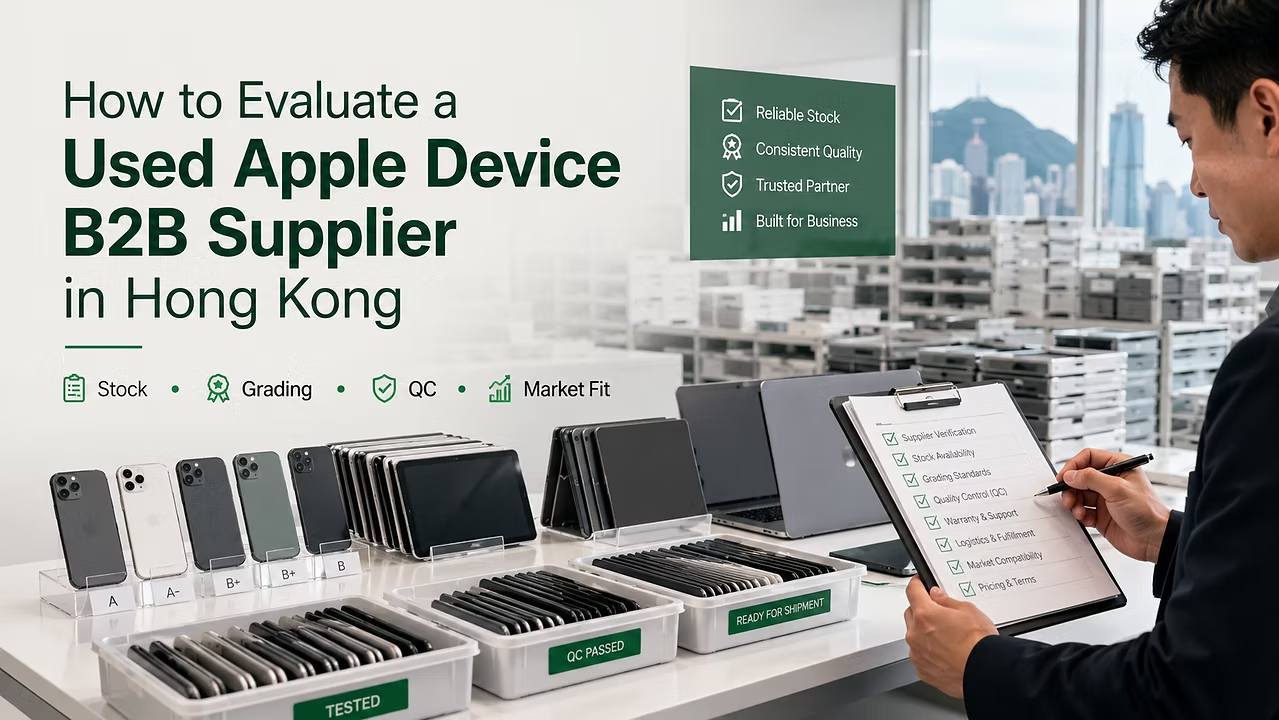
Buyers can review iPhonetree’s current Grading Standards to understand the condition ranges behind the grade names before comparing wholesale batches.
For B2B purchasing, the goal is not to find a grade label that sounds good. The goal is to understand what the grade actually means and how consistently the agreed specification is applied across the batch.
7. Match the Model to the Buying Requirement
There is no universal “winner” between the iPhone 14 Pro, 15 Pro and 15 Pro Max. A more useful comparison is to match each purchase against the buyer’s resale strategy.
| Buying Requirement | Model or Focus | What to Evaluate |
|---|---|---|
| Earlier-generation Pro inventory | iPhone 14 Pro | Price, grade, battery and region |
| Newer 6.1-inch Pro inventory | iPhone 15 Pro | Availability, storage mix and specification |
| Large-screen premium inventory | iPhone 15 Pro Max | Batch value and 256GB+ storage economics |
| Apple Intelligence support required | 15 Pro / 15 Pro Max | Focus on supported models |
| Physical SIM is important | Regional version | Confirm before comparing prices |
| Working capital is limited | Total batch value | Compare total value and sell-through |
| Premium resale channel | Condition consistency | Weight grade, battery and cosmetics |
| Multi-market distribution | Region and SIM | Confirm by destination market |
The right answer therefore changes depending on the buyer. A distributor purchasing for several countries may make a different decision from a retailer buying a premium-grade batch for one local market.
8. Build a Buying Specification Before Requesting Price
Instead of asking “How much is iPhone 15 Pro?”, a professional B2B enquiry should define the commercial requirement first.
For example:
“We are looking for 100–200 units of iPhone 14 Pro and iPhone 15 Pro, mainly 128GB and 256GB, with physical SIM support preferred. Please share available grades, battery specifications, regional versions and quantities.”
“We require iPhone 15 Pro Max 256GB for premium resale. Please confirm current quantity, regional version, grade, battery requirement and network status.”
A complete buying brief should ideally include:
Model
Storage
Quantity
Grade
Battery requirement
Regional version
SIM configuration
Network status
Destination market
Expected purchase timing
The clearer the requirement, the easier it is to filter unsuitable stock and compare the batches that actually fit the resale channel.
What B2B Buyers Should Check Before Ordering
1. Exact Model — Do not treat Pro and Pro Max as interchangeable.
2. Storage — Confirm whether the batch is single-storage or mixed.
3. Regional Version — Confirm the intended market and exact device version.
4. SIM Configuration — Especially important when comparing U.S. eSIM-only devices with other regional versions.
5. Network Status — Agree the required network specification before purchase.
6. Grade — Understand the cosmetic tolerance behind the grade name.
7. Battery — Define the required battery specification instead of assuming one universal standard.
8. Functional Condition — Confirm what has been tested and what standard applies.
9. Quantity — Confirm how many devices actually match the full agreed specification.
10. Destination Market — The batch should fit the market where it will ultimately be resold.
Frequently Asked Questions
Is the iPhone 14 Pro still relevant for wholesale buyers in 2026?
It can be. The iPhone 14 Pro remains a Pro-series device with ProMotion, Dynamic Island, A16 Bionic and a 48MP main camera. Whether it makes commercial sense depends on current batch pricing, grade, battery condition, regional specification and demand in the buyer’s resale market.
What is the main wholesale difference between iPhone 14 Pro and iPhone 15 Pro?
Beyond generation, key differences include Lightning versus USB-C, A16 Bionic versus A17 Pro, stainless steel versus titanium and Apple Intelligence support on the iPhone 15 Pro. B2B buyers should also compare actual batch price, storage, grade, battery and regional configuration.
Does a U.S. iPhone 15 Pro have a physical SIM tray?
No. U.S.-market iPhone 15 Pro and iPhone 15 Pro Max devices use eSIM and do not have a physical SIM tray. Wholesale buyers should confirm the regional version when physical SIM support is required.
Does the iPhone 14 Pro support Apple Intelligence?
No. Apple’s current Apple Intelligence-supported iPhone range includes the iPhone 15 Pro and iPhone 15 Pro Max and later supported models. Feature availability can vary by software version, language and region.
Which storage capacity is better for wholesale resale?
There is no universal answer. The appropriate storage mix depends on local customer demand, acquisition cost, resale price and inventory turnover. Buyers should evaluate storage as part of the complete batch rather than selecting capacity in isolation.
Is the iPhone 15 Pro Max automatically more profitable than the iPhone 14 Pro?
No. A newer or more expensive model does not automatically create a higher wholesale margin. Profitability depends on acquisition cost, resale value, grade, battery, regional specification, sellable yield, logistics, exceptions and inventory turnover.
How should a B2B buyer request current iPhone 14 Pro or iPhone 15 Pro stock?
Send the target model, storage, quantity, grade, battery requirement, regional version or SIM preference and destination market. This allows the supplier to match the requirement against current batches rather than sending an unfocused stock list.
The Bottom Line
The iPhone 14 Pro, iPhone 15 Pro and iPhone 15 Pro Max should not be compared only by generation or technical specifications.
The iPhone 14 Pro can occupy a different acquisition and resale position from the 15 Pro. The iPhone 15 Pro adds USB-C, A17 Pro and Apple Intelligence support while maintaining the smaller Pro form factor. The iPhone 15 Pro Max moves further into premium inventory with a larger display and 256GB minimum capacity.
But none of these factors makes one model universally better for every B2B buyer. The right batch is the one that matches the buyer’s resale market, meets an agreed specification and converts into predictable sellable inventory.
Looking for current iPhone 14 Pro, iPhone 15 Pro or iPhone 15 Pro Max wholesale stock? Contact the iPhonetree B2B team on WhatsApp with your target model, storage, grade, quantity, regional version and destination market.
In this article
Need current stock?
Share your target models, grades and quantity with our Hong Kong team.
View Stock