

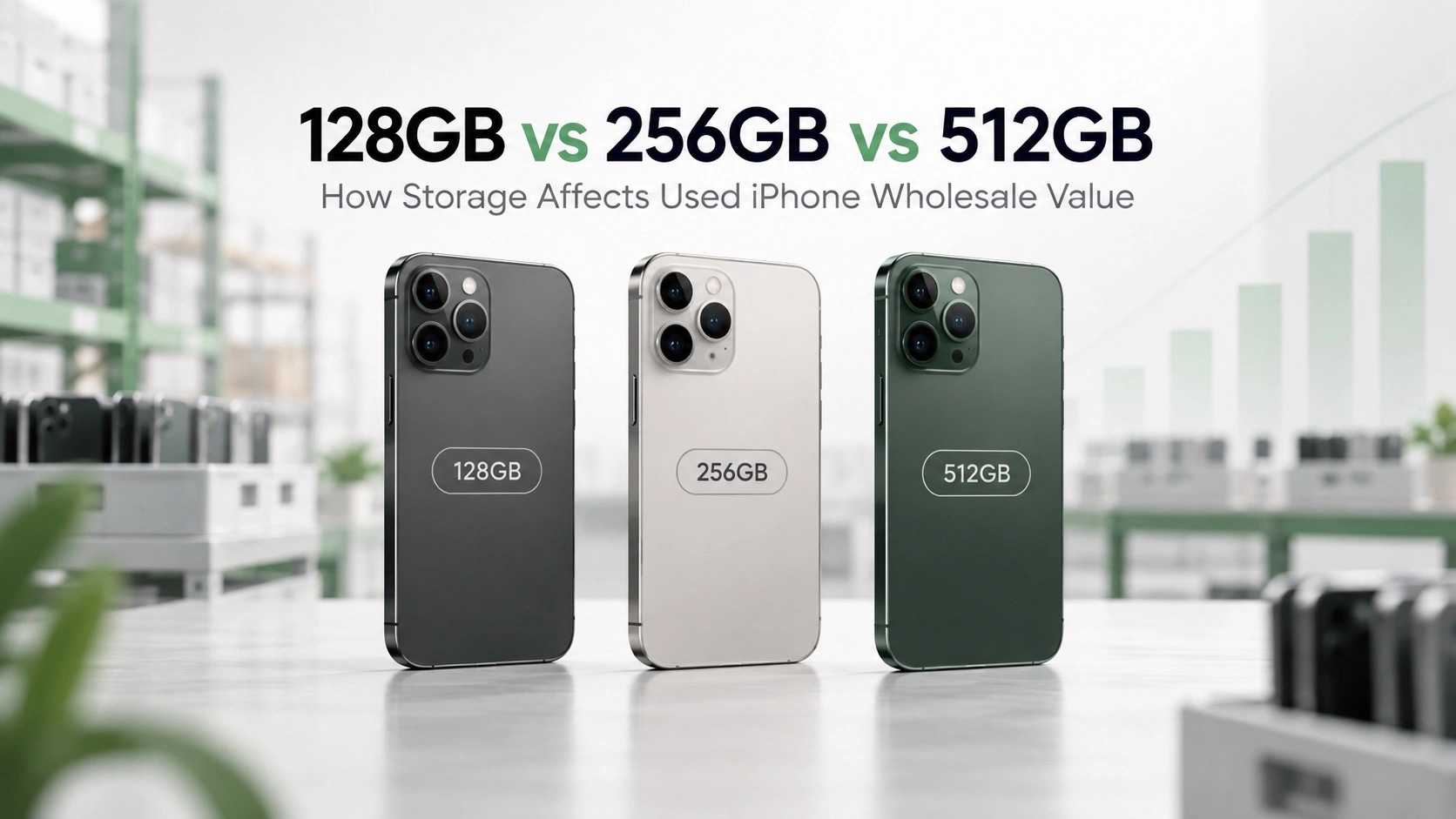
Storage is not just a technical specification when buying used iPhones in bulk. For B2B buyers, the difference between 128GB, 256GB and 512GB can affect: acquisition cost, resale price, working capital, buyer demand and inventory turnover. The most expensive storage option is not automatically the most profitable one. The more useful question is: Will the resale market absorb the extra storage premium paid at purchase? That is the key to understanding storage value in used iPhone wholesale.
The Short Answer
There is no universally best storage size for wholesale. Within the same iPhone model and a comparable condition, region and specification: • 128GB generally requires less capital per unit. • 256GB requires a higher purchase price, so buyers should check whether the downstream resale premium justifies that additional cost. • 512GB usually sits in a higher price band, but it also increases capital exposure and requires sufficient demand at the higher resale price. In other words: Higher storage does not automatically mean higher wholesale profitability. Storage should always be evaluated together with model, condition, region, purchase price and target market. This guide focuses on 128GB, 256GB and 512GB. Some Pro and Pro Max models are also available in 1TB, and the same storage-premium logic can be applied to those configurations.
1. Storage Is an Inventory Variable, Not Just a Specification
For a consumer, the storage question is usually: “How much space do I need for photos, videos and apps?” For a wholesale buyer, the questions are different: • How much more does this capacity cost me? • How much more can I realistically resell it for? • What price band does it move the device into? • Does my market have enough buyers at that price? • How many units can I purchase with the same working capital? • How quickly is the inventory likely to move? This changes the way storage should be evaluated. In used iPhone wholesale, storage is both a device specification and an inventory variable. Two batches of the same iPhone model can create very different inventory economics simply because their storage mix is different.
2. 128GB vs 256GB vs 512GB: The B2B Difference
A simple way to compare the three capacities is:
| Storage | Typical inventory characteristic | What B2B buyers should evaluate |
|---|---|---|
| 128GB | Usually a lower acquisition price within the same model | Whether lower cost improves price competitiveness and turnover |
| 256GB | Sits between entry and higher-capacity inventory | Whether buyers will pay enough additional resale premium |
| 512GB | Usually requires greater capital per unit | Whether high-capacity demand can support the higher price and inventory exposure |
This is not a ranking. It would be inaccurate to assume that: • 128GB always sells fastest; • 256GB is always the most profitable; • 512GB always sells slowly. Actual performance depends on: Model × Market × Price × Condition × Buyer Type Storage only makes sense inside that wider buying context.
3. 128GB: Lower Capital Entry, but Market Fit Still Matters
Within the same model and comparable specification, 128GB will generally sit at a lower acquisition price than higher-capacity versions. For a wholesale buyer, that can reduce the amount of working capital tied up in each unit. With a fixed purchasing budget, lower-capacity stock may allow a buyer to acquire more devices. That can make 128GB worth considering for channels focused on: • competitive retail pricing; • volume distribution; • faster inventory rotation; • tighter working-capital control. But lower acquisition cost does not automatically make 128GB the better buy. The real question is: Does the lower purchase price translate into better sell-through for this specific model and market? Storage demand can change with product generation and device tier. A 128GB standard-model iPhone and a 128GB Pro model may serve very different buyers even though the storage figure is identical.
4. 256GB: Evaluate the Premium, Not the Label
256GB is often described as a middle storage option. For B2B buyers, that description alone is not useful enough. The more important comparison is: How much more do you pay to move from 128GB to 256GB? versus: How much more will your downstream market pay for 256GB? If the additional resale value comfortably supports the additional purchase cost—and demand remains healthy—256GB can make commercial sense. If the market is highly price-sensitive, however, the extra purchase cost may simply increase inventory exposure. So the right question is not: “Is 256GB the best storage?” It is: “Is the resale premium large enough to justify the purchase premium?” This distinction matters much more in wholesale.
5. 512GB: Higher Resale Value Does Not Automatically Mean Higher Profit
Higher-capacity versions usually sit in a higher price band when comparing the same model and similar device condition. But for a wholesaler: Higher resale value is not the same as higher wholesale profitability. Consider a 100-unit order. If every 512GB device costs more than its 128GB or 256GB equivalent, that capacity premium is multiplied across the whole batch. The result is greater: Working Capital Exposure The downstream market must then contain enough customers who are willing to pay for the higher-capacity device. The important question is therefore not: “Can I sell 512GB for more?” It is: “Can my market absorb that higher price within an acceptable sell-through period?” If demand at the higher price band is limited, 512GB can create greater inventory pressure. That does not mean 512GB always moves slowly. Premium retail channels, Pro / Pro Max buyers and particular markets may have strong demand for higher-capacity devices. The key variable remains: Market fit.
6. The Most Important Concept: Storage Premium
A practical way to evaluate capacity is to think in terms of the: Storage Premium Take two comparable units: iPhone 15 Pro 128GB and iPhone 15 Pro 256GB The difference in purchase price represents an additional storage premium paid by the wholesale buyer. The buyer should compare two things: Purchase Premium How much more does the higher-capacity unit cost to acquire? Resale Premium How much more will the downstream customer realistically pay? A simple way to think about the decision is:
This is not intended as an industry-standard accounting formula. It is simply a practical framework for evaluating whether paying more for storage creates better inventory economics. The principle is straightforward: Do not assume that a higher-capacity phone creates more profit simply because its selling price is higher. If the purchase premium is large but the resale premium is limited—or if the device takes significantly longer to sell—the storage upgrade may not improve the overall return.
7. Storage Must Be Evaluated Together With the Model
One of the most common mistakes is treating storage as an independent buying variable. In reality: 128GB has no universal wholesale value on its own. The more useful unit of analysis is: Model × Storage For example: iPhone 13 128GB and iPhone 15 Pro 128GB both have the same storage capacity. But their: • product generation; • acquisition cost; • target customer; • resale price band; are very different. The same applies to: iPhone 14 Pro 256GB and iPhone 15 Pro Max 256GB. The number “256GB” is the same, but the inventory is not commercially equivalent. For a broader comparison of those Pro-series models, see our Used iPhone 14 Pro vs 15 Pro vs 15 Pro Max Wholesale Buying Guide.
8. A Useful Example: iPhone 15 Pro vs iPhone 15 Pro Max
The iPhone 15 Pro was offered in: 128GB / 256GB / 512GB / 1TB while the iPhone 15 Pro Max starts at: 256GB / 512GB / 1TB That distinction is useful when evaluating inventory. For the iPhone 15 Pro, 256GB represents a step above the 128GB entry configuration. For the iPhone 15 Pro Max, 256GB is already the starting capacity. However, this does not mean that starting capacity alone determines wholesale value. An iPhone 15 Pro 256GB and an iPhone 15 Pro Max 256GB still need to be evaluated as different products because their: Model Tier Acquisition Cost Downstream Price Target Buyer are different. The correct buying logic is therefore not: Storage = 256GB but: Model + Storage + Price + Market Fit
9. Single-Storage Batch vs Mixed-Storage Batch
Storage also affects how the entire batch is structured. Consider: Batch A 100 × iPhone 15 Pro 256GB versus: Batch B 40 × iPhone 15 Pro 128GB 45 × iPhone 15 Pro 256GB 15 × iPhone 15 Pro 512GB These are two very different inventory strategies. Single-Storage Batch A single-storage batch can make it easier to: • manage SKUs; • maintain consistent pricing; • communicate inventory clearly; • distribute stock to buyers with a defined specification. But this only works well when there is sufficient demand for that storage size. If demand is weak, concentrating the entire batch in one capacity can increase inventory risk. Mixed-Storage Batch Mixed storage can give a buyer: • access to several price bands; • more flexibility for different retail customers; • less concentration in a single capacity. The trade-off is greater complexity: • more inventory lines; • multiple resale prices; • different sell-through speeds by capacity. Neither structure is universally better. The right storage mix depends on how the buyer's sales channel actually moves inventory.
10. In Real B2B Sourcing, Storage Is Rarely Enough on Its Own
A request such as: “iPhone 15 Pro 256GB” is still incomplete from a wholesale sourcing perspective. A usable buying specification normally needs additional variables: Model Storage Condition / Grade Region / SIM Quantity Destination For example: Model: iPhone 15 Pro Storage: 128GB / 256GB Quantity: 100–200 units Region / SIM: Required specification Condition: Required standard Destination: Target market If mixed storage is acceptable, the buyer can be even more specific: 128GB — 40 units 256GB — 50 units 512GB — 10 units This allows the supplier to answer a much more important question: How many devices actually match the complete buying specification? Rather than simply saying: “We have 100 iPhone 15 Pro units.” This is one of the reasons professional B2B sourcing should be based on the complete batch specification rather than model name alone.
11. Which Storage Should a B2B Buyer Choose?
Instead of looking for one “best” capacity, start with the commercial objective.
| Buyer priority | What to evaluate | |
|---|---|---|
| Lower capital per unit | 128GB acquisition advantage | |
| Higher resale positioning | Purchase premium vs resale premium on 256GB | |
| Premium / high-capacity demand | Real market demand for 512GB | |
| Working-capital control | Total batch acquisition value | |
| Faster inventory turnover | Actual local storage demand | |
| Multiple retail price bands | Mixed-storage inventory | |
| Simpler quoting and inventory management | Single-storage batches |
The question should therefore move from: Which storage is better? to: Which storage structure fits my market and resale channel?
12. Storage Is Only One Part of the Buying Specification
No storage capacity should be evaluated in isolation. A complete used iPhone wholesale batch should normally be considered across: Model Storage Condition / Grade Region / SIM Network Status Quantity Purchase Price Target Market That means: “iPhone 15 Pro 256GB” is not a complete B2B buying specification. The commercial value of the inventory comes from the combination of: Model × Storage × Condition × Region × Price × Market Fit Buyers can review current used iPhone wholesale options before preparing a more specific buy list.
Conclusion: Do Not Ask Which Storage Is Worth More
128GB, 256GB and 512GB all have a place in the used iPhone market. 128GB can reduce capital required per unit within a comparable model. 256GB should be evaluated by comparing the additional purchase premium with the resale premium available downstream. 512GB can move inventory into a higher-value price band, but it also increases working-capital exposure. The most useful question is therefore not: Which storage has the highest value? It is: Which storage best fits my customers, resale price band and inventory-turnover target? Or more simply: Do not look only at storage value. Look at whether your market can absorb the storage premium. For B2B buyers, the most valuable storage configuration is the one that can be resold at an acceptable margin and within an acceptable period of time.
Frequently Asked Questions
Is 128GB still suitable for used iPhone wholesale?
Yes. The decision depends on the model, purchase price, condition and target market. Within the same model and comparable specification, 128GB generally requires less capital per unit, but its commercial value ultimately depends on local demand.
Is 256GB always better than 128GB for wholesale?
No. Buyers should compare the additional acquisition cost of 256GB with the additional resale premium available downstream. If the market does not pay enough for the extra capacity, the higher storage option may not generate a better return.
Does a 512GB used iPhone have higher resale value?
Within the same model and comparable condition, a higher-capacity device will generally sit in a higher price band. However, higher resale price does not automatically mean higher profitability because acquisition cost, working capital and sell-through also matter.
Why can higher-capacity iPhones create more inventory pressure?
Higher-capacity devices typically move into a higher resale price band. If demand at that price level is limited in the target market, sell-through may slow and more working capital may remain tied up in inventory.
Is a single-storage batch better than a mixed-storage batch?
Not necessarily. Single-storage batches are easier to manage and quote consistently. Mixed-storage batches can cover more customer budgets and resale price points, but they also increase inventory complexity.
Why does the iPhone 15 Pro Max not have a 128GB option?
The iPhone 15 Pro Max starts at 256GB, while the iPhone 15 Pro was also offered in 128GB. This is an important product-structure difference, but starting capacity alone does not determine wholesale value.
In this article
Need current stock?
Share your target models, grades and quantity with our Hong Kong team.
View Stock