

A wholesale stock list tells you what is available.
It does not tell you what you should buy.
For professional wholesalers, distributors and resellers, the lowest quoted unit price is rarely enough to determine whether a used iPhone batch is commercially attractive.
Two batches can contain the same model, storage and stated grade, yet produce very different results after resale.
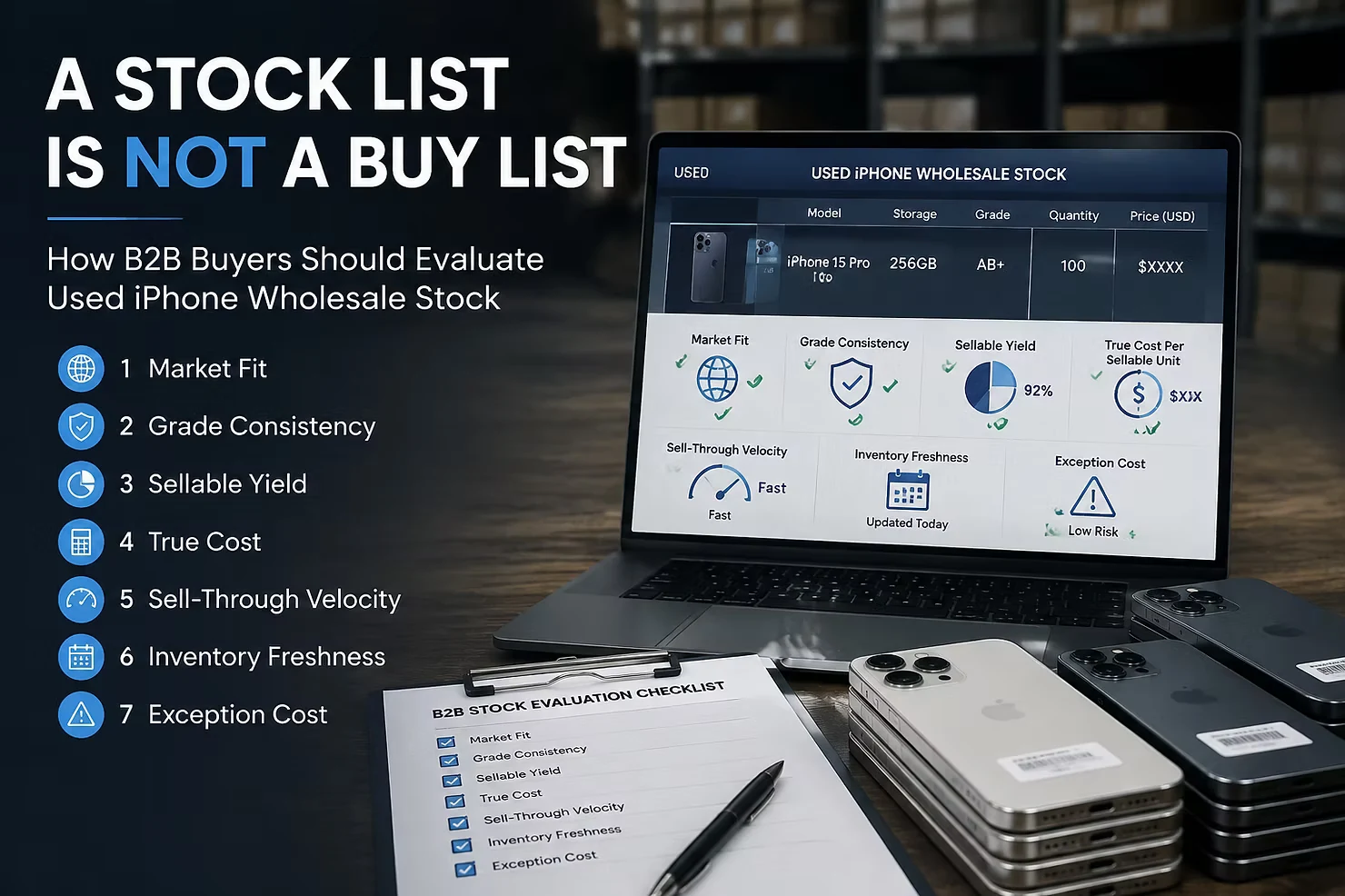
A more useful way to evaluate wholesale stock is to look at seven factors:
Market Fit · Grade Consistency · Sellable Yield · True Cost · Sell-Through Velocity · Inventory Freshness · Exception Cost
Together, these factors turn a stock list from a catalogue into a purchasing tool.
1. Market Fit: Will This Batch Actually Sell in Your Market?
Consider a stock list showing:
iPhone 15 Pro · 256GB · AB+ · 100 units
That is not yet enough information to make a buying decision.
A professional buyer may still need to confirm:
Regional version
SIM configuration
Network status
Battery requirement
Grade tolerance
Quantity under the exact same specification
The first question should therefore not be:
“Is this a good price?”
It should be:
“Does this batch fit my resale market?”
A configuration that works well for one market may be less attractive in another. For example, regional version, physical SIM support, eSIM configuration and storage mix can all influence resale suitability.
When working with a used iPhone B2B supplier in Hong Kong, buyers should define these market requirements before comparing batches purely on price.
2. Grade Consistency: Compare the Standard Behind the Letter
A common mistake in used iPhone wholesale is assuming that the same grade means the same condition everywhere.
It does not.
Terms such as S, AB+, AB, B+ or B are only useful when the buyer understands the tolerance behind them.
Instead of asking only:
“Is this AB+?”
A better question is:
“What condition variation is accepted inside this AB+ batch?”
Professional buyers may want to understand:
Scratch tolerance
Dent tolerance
Screen condition
Frame condition
Functional acceptance criteria
How consistently the standard is applied across the batch
The key principle is:
The grade name matters less than the consistency of the specification behind it.
A slightly broader grade with predictable tolerance may be commercially easier to manage than a supposedly higher grade with large variation between units.
Grade ≠ Battery Specification
Cosmetic condition and battery condition should also be treated separately unless the supplier explicitly combines them into one grading standard.
A device can look excellent cosmetically while having a battery condition that does not fit the buyer's resale requirement.
If battery health matters commercially, it should be agreed as a separate specification.
3. Sellable Yield: How Much of the Batch Fits Your Channel?
A stock list may show:
Quantity: 500 units
But the more useful question is:
How many of those 500 units actually fit my intended resale channel without additional work?
This leads to a practical purchasing concept:
Sellable Yield
Sellable Yield = Units meeting the buyer's agreed resale specification ÷ Total units received
This is not an accounting standard or universal industry metric. It is a practical way to evaluate how useful a batch is commercially.
Imagine a hypothetical 100-unit order. If four units fall outside the agreed cosmetic tolerance, three do not fit the required regional specification and two need additional handling, then 91 units may initially fit the buyer's intended resale channel.
The original quantity was 100. The immediately sellable quantity may be different.
This difference becomes increasingly important as order size grows.
For a small test order, a few exceptions may be manageable. For a recurring 500-unit or 1,000-unit programme, even small changes in sellable yield can materially affect margin, labour and customer satisfaction.
4. True Cost per Sellable Unit: The Cheapest Quote May Not Be the Cheapest Batch
Wholesale buyers often compare suppliers using one number: unit price.
But quoted unit price and commercial buying cost are not always the same.
A more useful management framework is:
True Cost per Sellable Unit
(Purchase Cost + Freight / Landed Costs + Rework + Expected Exception Costs + Inventory Holding Costs) ÷ Sellable Units
This is a management framework, not an accounting or tax standard. Buyers should adapt it to their own logistics, tax treatment and operating model.
Worked Example
Consider two hypothetical batches:
| Batch | Purchase cost | Immediately suitable units | Effective cost per suitable unit |
|---|---|---|---|
| Batch A | 100 × USD 400 = USD 40,000 | 90 | USD 444.44 |
| Batch B | 100 × USD 410 = USD 41,000 | 98 | USD 418.37 |
At first glance, Batch A appears cheaper. But the batch with the higher quoted price may create the lower effective cost per suitable unit.
Illustrative example only. These figures do not represent an actual iPhonetree transaction or typical industry defect rate.
The principle is simple:
Cheaper unit price does not always mean lower commercial cost.
5. Sell-Through Velocity: How Quickly Does the Stock Turn Back Into Cash?
A stock list does not tell you how quickly the inventory will sell.
But for a wholesaler, inventory turnover can matter almost as much as unit margin.
Consider another simplified example: SKU A may offer a USD 30 potential gross margin and sell through in 10 days, while SKU B may offer USD 45 but take 60 days.
The higher-margin SKU is not automatically the better commercial decision.
A professional buyer may also consider:
Capital tied up
Local demand
Expected price depreciation
Storage and operating cost
Speed of replenishment
Opportunity cost
This is particularly relevant in used iPhone wholesale, where device values can change after new model launches, retail promotions or shifts in secondary-market supply.
The goal is therefore not simply “buy cheap and sell high.” It is to buy stock that can convert back into cash efficiently at an acceptable margin.
6. Inventory Freshness: Is the Stock Still Really Available?
A wholesale stock list is a snapshot.
It is not automatically a guarantee that the same quantity will still be available when the buyer is ready to confirm an order.
For fast-moving inventory, buyers should ask:
When was the stock last confirmed?
Is the quantity physically available?
Does the quantity still match the listed specification?
Can the batch be reserved?
Is the offer based on current stock or expected supply?
This is the difference between “this model exists on the website” and “this batch is available today against the agreed specification.”
For professional B2B buyers, inventory freshness is part of stock quality.
7. Exception Cost: What Happens When Something Falls Outside Specification?
A stock list explains what should be supplied.
A professional trading process should also explain what happens when something does not match the agreed specification.
Before confirming a significant order, buyers should understand questions such as:
What happens if a unit falls outside the agreed grade?
What happens if the regional version is incorrect?
What happens if there is an unexpected functional issue?
What evidence is required for a claim?
How long is the claim window?
Is the resolution a replacement, credit or another arrangement?
How are return logistics handled where applicable?
This matters because a small unit-price advantage can disappear quickly when an exception becomes expensive to resolve.
Professional buyers should therefore compare:
Price + Specification + Exception Handling
rather than price alone.
The 7-Metric B2B Batch Evaluation Framework
Before purchasing used iPhone wholesale stock, evaluate the batch across seven dimensions:
| Metric | Core Question |
|---|---|
| Market Fit | Will this specification sell in my market? |
| Grade Consistency | How predictable is the condition inside the stated grade? |
| Sellable Yield | How many units are likely to meet my resale specification? |
| True Cost | What will each sellable unit actually cost me? |
| Sell-Through Velocity | How quickly can this inventory convert back into cash? |
| Inventory Freshness | Is the listed stock still available under the same specification? |
| Exception Cost | What happens financially and operationally if something falls outside specification? |
A stock list becomes much more useful when buyers evaluate all seven rather than comparing unit price in isolation.
Buyer Sees vs Professional Buyer Asks
| Buyer Sees | Professional Buyer Asks |
|---|---|
| iPhone 15 Pro | Which regional version? |
| 256GB | Is the storage specification confirmed across the batch? |
| AB+ | What tolerance defines AB+? |
| 100 units | Do all 100 match the agreed specification? |
| USD XXX | What is my true cost per sellable unit? |
| Battery ≥ X | Is this an agreed requirement for each unit? |
| Unlocked | How is network status confirmed? |
| Ready Stock | When was the quantity last verified? |
A stock list answers what is available. The right questions determine whether it is worth buying.
Turn Your Buying Request Into a Specification
Buyers can also improve stock matching by sending clearer requirements.
Instead of:
“Send your iPhone list.”
A more useful request would be:
“We are looking for 150–200 units of iPhone 14 Pro and iPhone 15 Pro, 128GB/256GB, AB+ or AB, unlocked, with physical SIM support preferred. Destination market: UAE.”
Or:
“We require recurring used iPhone stock for Europe. Please share available iPhone 13–15 models by grade, storage, regional version and quantity. Battery requirement: [buyer specification].”
A professional buying request should ideally define:
Model · Storage · Grade · Regional Version · SIM Configuration · Network Requirement · Battery Requirement · Quantity · Destination Market
The clearer the requirement, the less time both buyer and supplier spend filtering unsuitable stock.
How iPhonetree Applies This Framework
iPhonetree is a Hong Kong-based B2B supplier of used iPhones and other pre-owned Apple devices.
Our approach to wholesale sourcing is to define the buyer's commercial specification first, then match available stock against it.
Depending on the batch and buying requirement, this may include model, storage, grade, regional version, SIM specification, network status, battery requirement and quantity.
Because wholesale inventory changes continuously, buyers should confirm current availability rather than relying on an outdated static price list.
Methodology Note
“Sellable Yield”, “True Cost per Sellable Unit” and the seven-metric framework in this article are practical purchasing concepts used by iPhonetree to explain B2B stock evaluation. They are not accounting standards, tax rules or universal industry grading standards.
All numerical examples in this article are hypothetical unless explicitly stated otherwise.
The Bottom Line
A stock list is not a buy list.
The cheapest batch is not necessarily the most profitable batch.
The largest quantity is not necessarily the most useful quantity.
And the highest grade label is not necessarily the most consistent batch.
Professional buyers should evaluate used iPhone wholesale stock through:
Market Fit · Grade Consistency · Sellable Yield · True Cost · Sell-Through Velocity · Inventory Freshness · Exception Cost
The better buying decision is the stock that fits the resale market, meets an agreed specification and converts into predictable commercial value.
In this article
Need current stock?
Share your target models, grades and quantity with our Hong Kong team.
View Stock