

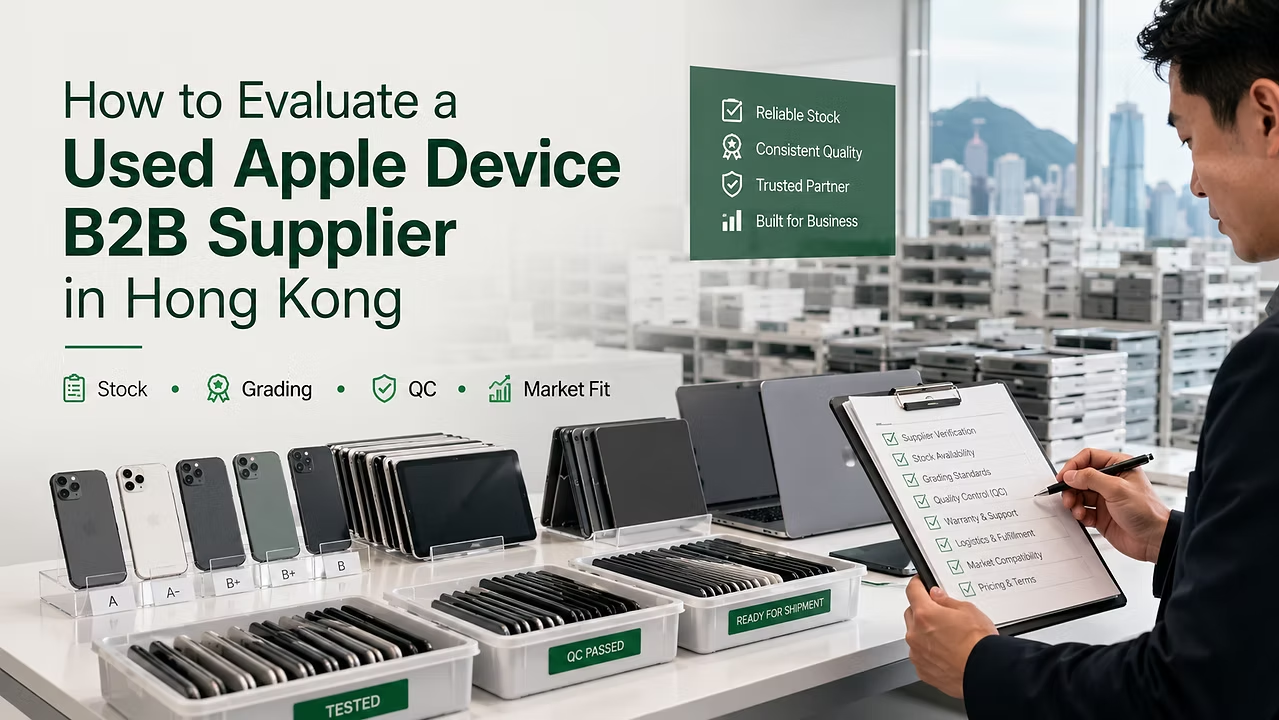
There is no single “best” used Apple device supplier for every professional buyer.
A wholesaler purchasing hundreds of price-sensitive devices for one market may need something very different from a retailer sourcing higher cosmetic grades for another. A refurbisher may prioritize functional condition and repair economics, while a distributor may care more about quantity consistency, regional specifications and predictable replenishment.
B2B supplier evaluation should consider stock availability, grading clarity, quality control, batch specifications and destination-market fit — not unit price alone.
For that reason, choosing a B2B supplier should not begin with the question:
“Who has the lowest unit price?”
A better question is:
“Which supplier can provide a batch that fits my product requirement, resale market and commercial model?”
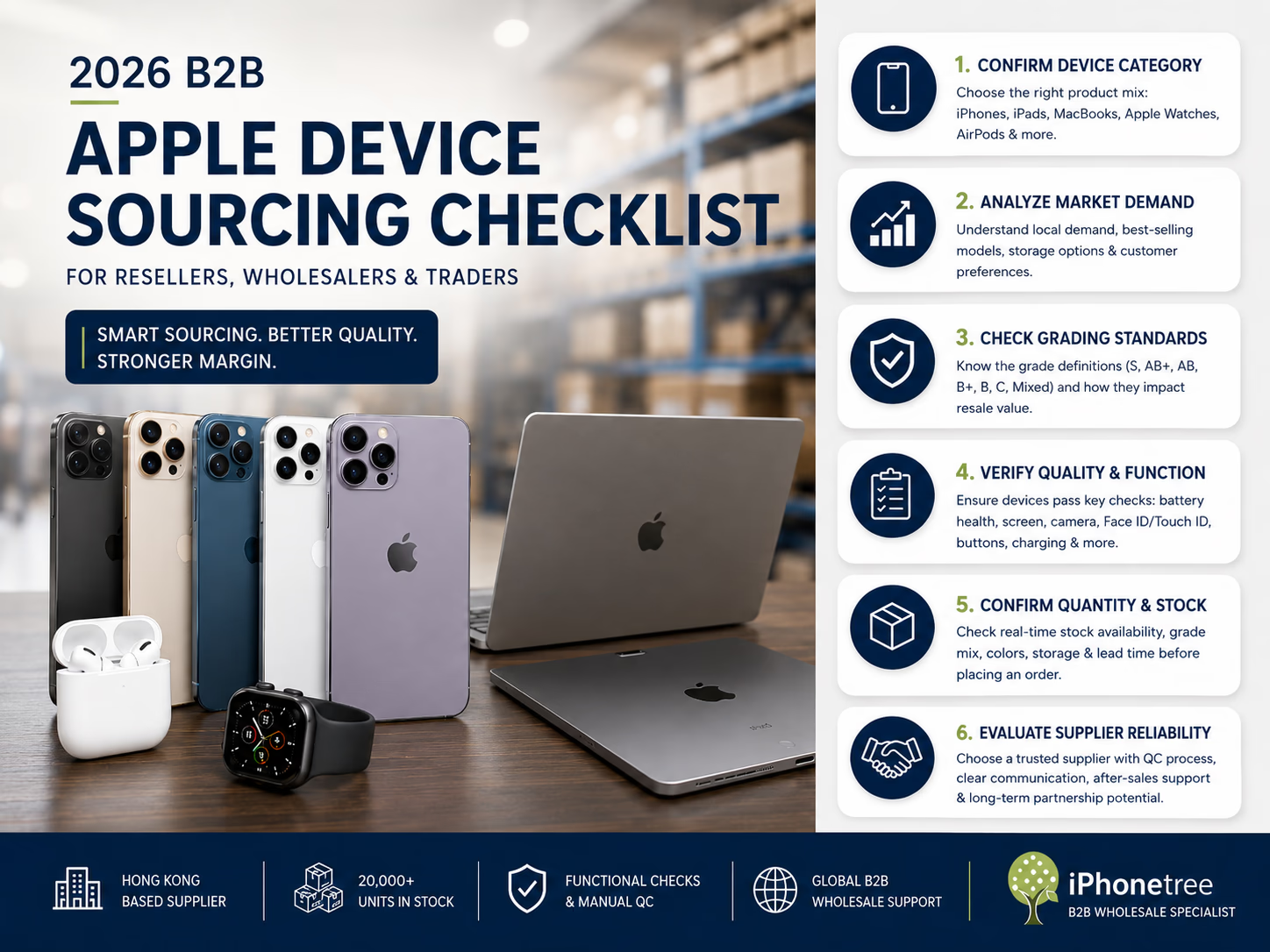
For buyers sourcing used iPhones, iPads, MacBooks and other pre-owned Apple devices from Hong Kong, the following framework can make supplier comparisons more useful.
1. Verify Real Stock Availability
A stock list is useful, but it should not automatically be treated as a buy list.
The first question is whether the quantity shown is actually available within the specification you require. Seeing 500 units of a particular iPhone model does not necessarily mean that all 500 share the same storage, cosmetic grade, regional version, SIM configuration, network status, battery requirement and functional condition.
A professional buyer should therefore separate headline quantity from usable quantity. Before comparing suppliers, ask:
Is the stock currently available and is the quantity confirmed?
How much of the batch matches the specification I need?
Is the batch homogeneous or mixed?
Can the supplier confirm the specification before the order?
This becomes increasingly important when the buyer needs a consistent resale proposition rather than simply the largest possible number of units.
2. Understand What the Grade Actually Means
Grade terminology is not standardized across the global used-device industry. A “Grade A” phone from one supplier may not look the same as a “Grade A” phone from another. That makes the letter itself less useful than the definition behind it.
A buyer should ask what cosmetic wear the grade allows:
Are screen scratches allowed?
How visible can frame marks be?
Are dents acceptable?
Is paint loss allowed?
How much variation can exist inside one batch?
This is the difference between a grade name and a grading standard. For wholesale purchasing, consistency can matter as much as the nominal grade. A retailer may sell 100 units with minor cosmetic wear efficiently if the condition is predictable, but may struggle with a batch containing a wide range of appearances even when every unit carries the same grade label.
Grade name ≠ grade consistency.
Ask for the definition and understand the tolerance.
3. Separate Cosmetic Grade from Functional Condition
Cosmetic condition and functional condition are related, but they are not the same thing. A device can look very clean and still have a functional issue. Another device can show visible cosmetic wear while remaining fully suitable for a particular resale or refurbishment channel.
Professional supplier evaluation should therefore treat these as two separate questions.
Cosmetic condition asks: What does the device look like?
Functional condition asks: What has been tested and what functions are expected to operate according to the agreed specification?
For an iPhone, relevant checks may include display, touchscreen, cameras, charging, physical buttons, connectivity, biometric functions where applicable, battery information, and system or network status. The exact test process can vary between suppliers and product categories.
The important question is not simply “Are the devices tested?” Ask: “What is actually tested?”
4. Confirm Product Specifications Beyond the Model Name
One of the easiest mistakes in B2B device sourcing is comparing two offers only by model. Consider the description:
iPhone 15 Pro 256GB
It sounds specific, but depending on the buyer's market, it may still be incomplete. A professional buyer may also need to know:
Regional version
Physical SIM / eSIM configuration
Network status
Cosmetic grade
Battery requirement
Quantity within specification
For an iPad, generation, screen size, storage, Wi-Fi or Cellular configuration and cosmetic grade can be more important. For a MacBook, the specification changes again: model, screen size, chip or processor, memory, SSD capacity, keyboard layout, battery condition and cosmetic grade.
A professional B2B supplier should be able to discuss products using commercial specifications, not only model names.
5. Confirm Regional Version and SIM Configuration for iPhones
Regional specifications can materially affect the resale suitability of an iPhone batch. Depending on model generation and destination market, buyers may care about differences such as physical SIM and eSIM configurations or other region-specific characteristics.
This does not mean one regional version is universally better than another. It means the batch needs to fit the market in which it will be resold. Before buying, an iPhone wholesaler should ask:
Which regional version is included?
Is the batch mixed or consistent?
What SIM configuration is present?
Are there network requirements?
Does this specification match the destination market?
Available stock ≠ market-fit stock.
6. Agree Battery Requirements Before Ordering
Battery condition is one of the most frequently discussed topics in used-device purchasing. It is also a topic where vague assumptions can quickly create disagreements.
Instead of assuming that every supplier uses the same threshold, buyers should clarify the requirement before the order:
Is there an agreed battery-health requirement?
Does the requirement apply to the whole batch?
How are exceptions handled?
Is battery information recorded during QC?
Are other battery-related metrics relevant to this product category?
The right requirement depends on the buyer's resale channel and commercial model. A premium consumer-facing resale program may have different expectations from a refurbishment channel. Define the requirement before comparing the price.
7. Evaluate Batch Consistency, Not Only Individual Units
B2B purchasing is different from purchasing one used device: the commercial unit is often the batch.
Imagine two offers. Supplier A has 200 units at a slightly lower average price, but with substantial variation in grade, storage and specification. Supplier B has 180 units at a slightly higher price, but the majority closely match the buyer's target specification.
Which offer is cheaper? The answer cannot be determined from unit price alone. The buyer may also need to consider:
Sorting cost
Unsellable units and regrading
Redistribution and additional testing
Slower-moving configurations
Exception handling and staff time
This is why professional buyers should evaluate sellable yield rather than only total units received. A larger batch is not automatically a more useful batch.
8. Understand the Supplier's Quality-Control Process
“QC tested” sounds reassuring, but the phrase has little value without context. A stronger supplier discussion should explain:
Which functions are checked
When testing takes place
How cosmetic condition is verified
Whether order requirements are checked before shipment
How exceptions are identified
The depth of testing required can vary according to the product and commercial agreement. The purpose of QC in B2B sourcing is to reduce uncertainty between what the buyer believes they are purchasing and what is actually delivered. The process needs to be clear, relevant and consistently applied.
9. Consider the Destination Market
A commercially attractive device in one market may not have the same resale value in another. The destination market can influence preferences around cosmetic grade, storage, regional version, SIM configuration, keyboard layout, connectivity and price point.
For example, a MacBook configuration with one keyboard layout may be highly suitable for one market and less attractive in another. Similarly, two iPhone batches with the same model and storage may not be equivalent if their regional specifications differ.
“Who is the final buyer of this batch?”
The earlier that answer is defined, the easier it becomes to filter unsuitable stock before purchase.
10. Ask About Quantity and MOQ in Context
MOQ should not be evaluated as an isolated number. A very low minimum order quantity may be useful for trial orders, but it does not necessarily indicate whether a supplier can meet future purchasing requirements. Likewise, a large headline quantity does not guarantee that enough stock exists within the buyer's target specification.
Instead, buyers should consider:
Minimum practical order size
Quantity currently available
Quantity available within specification
Expected purchasing frequency
Ability to consolidate multiple models or grades where applicable
The relevant question is not simply “What is your MOQ?” It is: “Can the supplier support the volume and specification my business actually needs?”
11. Review Shipping and Commercial Terms
Stock quality is only one part of a wholesale transaction. Professional buyers should also clarify the commercial process. Depending on the transaction, relevant questions may include:
Incoterms
Payment terms
Shipment method and documentation
Delivery responsibility
Inspection timing
Order confirmation process
Not every supplier offers every shipping term, and not every arrangement is appropriate for every destination. Terms should be confirmed for the specific transaction rather than assumed from a generic website statement.
12. Ask How Exceptions Are Handled
No B2B sourcing process should be evaluated only on the assumption that every unit will always match expectations perfectly. Before ordering, buyers should understand what happens when something falls outside the agreed specification, including grade discrepancies, functional exceptions, specification differences, missing quantity and other agreed order deviations.
A strong commercial relationship is not created by pretending exceptions never happen. It is created by reducing ambiguity about how they are handled.
13. Compare True Cost, Not Only Unit Price
The lowest quoted unit price is not always the lowest commercial cost. A professional buyer may also incur costs from:
Regrading and additional QC
Repair and sorting
Redistribution and slower-moving stock
Units outside target specification
Operational time
A more useful calculation is:
True Cost per Sellable Unit
This shifts the buying decision from “Who quoted the cheapest unit?” to “Which batch produces the best commercial result after the stock enters my operation?” For large-volume purchasing, even small differences in sellable yield can materially change the economics of an order.
B2B Supplier Evaluation Checklist
| Area | Questions to Ask |
|---|---|
| Stock | Is the quantity actually available now? |
| Model | Is the exact model or generation confirmed? |
| Grade | What does the grade definition allow? |
| Consistency | How much variation exists inside the batch? |
| QC | What functions are actually checked? |
| Version | Is the regional specification confirmed where relevant? |
| SIM / Connectivity | Does it match the destination market? |
| Battery | What battery requirement has been agreed? |
| Quantity | How many units meet the target specification? |
| Destination | Is this stock suitable for the resale market? |
| Exceptions | What happens if units fall outside the agreed specification? |
| Terms | What shipping and commercial terms apply? |
So, What Makes a Good Used Apple Device B2B Supplier?
There is no universal supplier score that applies to every buyer. A strong supplier for one business might be the wrong fit for another.
Professional buyers should evaluate suppliers against their own commercial requirements:
Product specification
Grade clarity
Batch consistency
Quality-control transparency
Market fit
Commercial terms
The goal is not simply to find available devices. It is to find stock that can move efficiently through the buyer's resale channel.
About iPhonetree
iPhonetree is a Hong Kong-based B2B supplier of graded used and pre-owned Apple devices, including iPhones, iPads and MacBooks. Our sourcing approach is built around clearer batch specifications, grading standards, quality-control processes and current-stock matching for professional buyers.
Explore wholesale supply by product category
Share the models, grades, quantity and destination market you need, and our team can help match current stock to your commercial specification.
Explore Used iPhone Wholesale
Explore Used iPad Wholesale
Explore Used MacBook Wholesale
In this article
Need current stock?
Share your target models, grades and quantity with our Hong Kong team.
View Stock