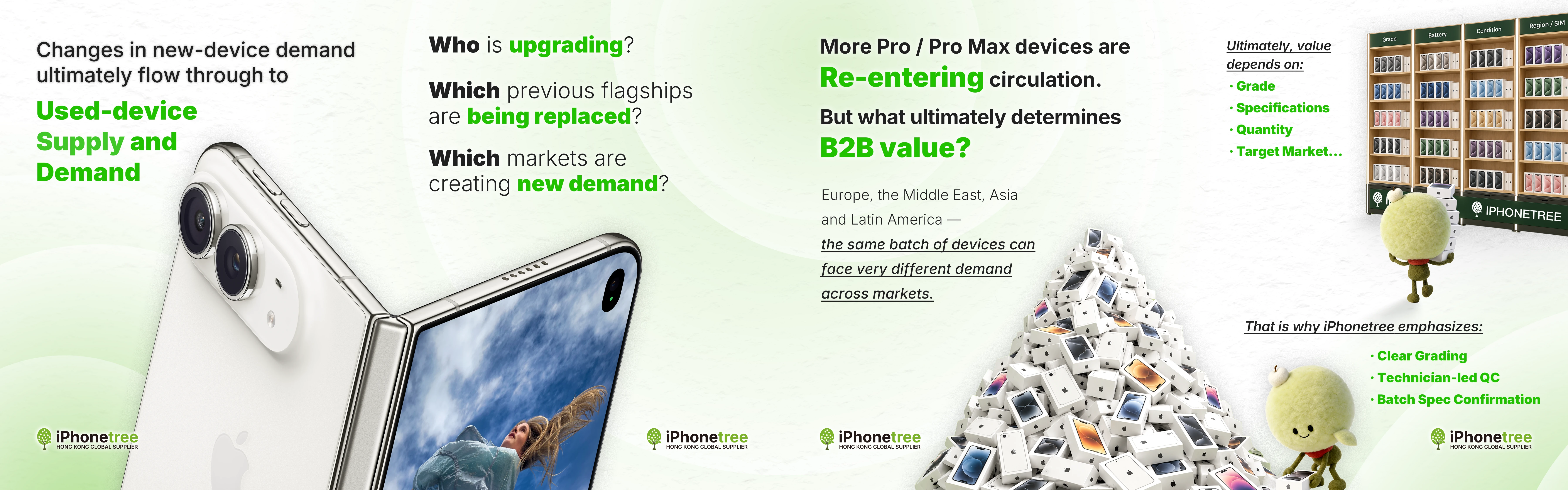


Apple has confirmed that its next event will take place on September 9, U.S. time. Consumers will naturally focus on new product specifications, pricing, and upgrade intentions. But for the used iPhone wholesale industry, another chain deserves closer attention: once new devices are sold, where will the older devices be released from, at what cost will they enter the wholesale market, how will they be tested, graded and restructured, and ultimately, which buyers and markets will absorb them?
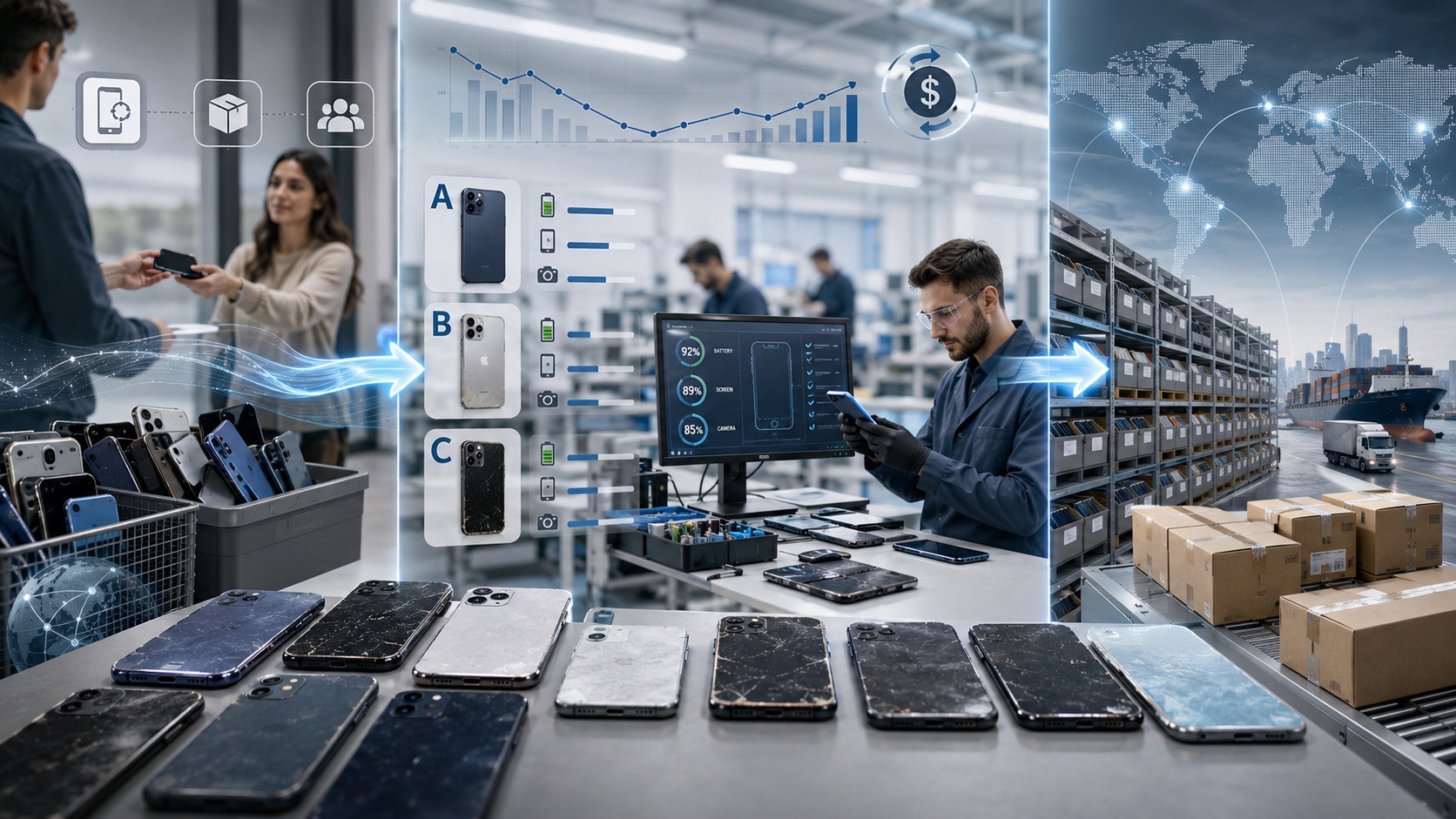
Therefore, what a new Apple product launch truly reprices is not simply the previous generation of iPhones, but the entire supply chain — from upstream sourcing, procurement pricing and untested devices to testing and grading, inventory turnover and final bulk sales.
Upstream, the First Question Is Not Price — It Is the Source of the Devices
Trade-in programs, carrier upgrades, enterprise device refresh cycles, consumer buybacks, auctions, large recyclers and traditional wholesale channels may all release more used devices after a new product cycle begins.
But for wholesale procurement, an increase in returned devices does not necessarily mean an increase in high-quality supply.
The same batch of 500 untested iPhones can have very different cosmetic grades, battery conditions, repair histories and failure rates depending on whether the devices come from carrier trade-ins, enterprise device refresh programs, consumer buybacks, auction lots or mixed inventory from different traders.
Therefore, the value of a batch of untested devices depends first on source quality and batch structure, and is then validated by the actual yield rate after testing.
This is also where misjudgment is most likely to occur during a new product cycle. What the market sees is falling prices. What procurement teams actually need to determine is: does the current price sufficiently account for the uncertainty within this batch?
A reasonable purchase price for a batch should essentially be calculated backwards from its downstream sales value:
Expected Sales Value − Grade & Functional Losses − Testing & Processing Costs − Logistics & Financing Costs − After-Sales Risk − Inventory Depreciation Risk − Target Profit
So the purchase price is only the starting point of cost, not the final cost.
From Untested to Tested, the Process Is Fundamentally a Restructuring of Commercial Value
Once devices enter the warehouse, the work that truly affects profitability begins.
Device identifiers and network status, battery condition, display, cameras, touchscreen, biometric functions, connectivity, component status, cosmetic condition, and whether the device is commercially saleable can all change the sales path it should ultimately enter.
After testing and quality control, a batch of original inventory may be reorganized into high-grade tested devices, different cosmetic grades, devices with different functional conditions, as-is devices and other inventory categories.
Therefore, a tested product is not simply an untested product with an additional testing process added to it.
The real value created is:
Transforming a batch with incomplete information into multiple clearly defined commercial inventory categories that can be priced separately and matched with different buyers.
What really needs to be calculated here is not the purchase price of each untested device, but:
The True All-In Cost of Every Saleable Device.
A batch may have a very low purchase price, but if the proportion of higher-value grades is insufficient after testing, the abnormal-device rate is high, and logistics, testing, after-sales costs and market depreciation during the holding period are added, the final cost per saleable device may not actually be low.
By contrast, a batch with a slightly higher purchase price but more stable sourcing, a better grade structure and a higher saleable-device ratio may ultimately deliver better gross margins and inventory turnover efficiency.
This is also why iPhonetree has continued to invest in testing, grading and batch management over the long term. What needs to be controlled is not one isolated part of the process, but the overall conversion efficiency of a batch from the moment it enters the warehouse until it becomes saleable inventory.
Profit in Used-Device Wholesale Must Account for Both “Time” and “Inventory Structure”
One of the biggest differences between used electronic devices and many traditional products is that inventory itself continuously depreciates.
Even if a batch is purchased at a reasonable price, if procurement, logistics, testing, grading and final sales take three to four weeks, while the market goes through another round of repricing during that period, what originally appeared to be an attractive profit margin may already have been consumed by the time the inventory was held.
However, in actual used iPhone wholesale, inventory risk cannot be evaluated only by asking “how long has the stock been held?” It is equally important to understand “which grades are ultimately being held?”
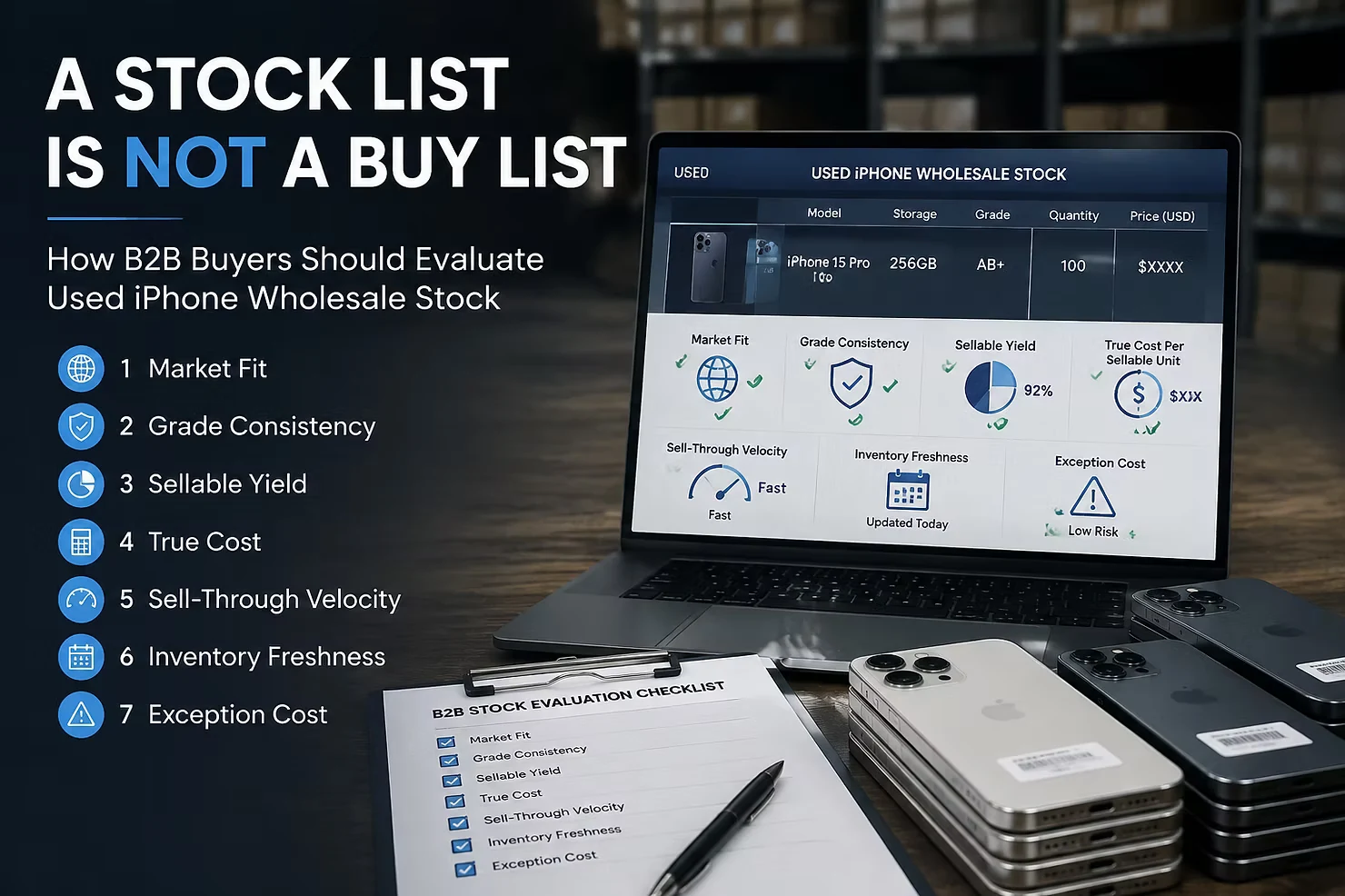
For example, when purchasing a batch of mixed untested inventory, what matters is not only the average purchase price of the entire batch. Buyers also need to estimate how many A/B-grade devices, how many C/D-grade devices, and other grade categories will be produced after testing, as well as the sales velocity of each grade in the current market.
Generally, A/B-grade devices have a broader buyer base and faster turnover. During a declining-price market, even if their profit per unit is not particularly high, depreciation risk can remain relatively manageable as long as there is already clear downstream demand.
By contrast, C/D-grade devices may appear to offer higher margins on paper, but if their sales velocity is slower, one or two rounds of market price reductions can cause inventory depreciation to erode — or even exceed — the original expected profit.
View iPhonetree Clear Grading Standards: https://www.iphonetree.com/grading
Therefore, in a rapidly changing market, product velocity can sometimes be more important than theoretical gross margin per unit.
This also means procurement and sales must work much more closely together.
Suppose downstream customers have already confirmed demand for 100 units of a certain model in A/B grades. A more rational procurement strategy is not to buy as much mixed untested inventory as possible. Instead, procurement should use historical yield rates, current batch quality and actual demand to calculate backwards how much original inventory needs to be purchased, with the goal of making the grade structure after testing match existing orders as closely as possible.
What really needs to be controlled is how much inventory in other grades — for which there may not yet be confirmed buyers — will be generated in the process of obtaining those 100 target-grade devices.
Because during the price-declining period following a new product launch, inventory accumulation itself becomes a form of risk exposure. If the sell-through speed of the remaining grades is slower than the rate at which market prices are falling, what initially looked like an attractive procurement margin can gradually be eroded by subsequent inventory depreciation.
Therefore, at this stage, a more mature procurement logic should be:
Start with real downstream demand, then work backwards to determine upstream procurement volume; first consider whether inventory can turn quickly, then determine whether the theoretical profit is high enough.
For used iPhone wholesale, what truly needs to be managed is not simply the purchase price and selling price, but the balance between gross margin, grade structure, inventory turnover and depreciation risk.
If you would like to check iPhonetree’s latest wholesale prices and current inventory, contact our B2B team directly on WhatsApp: http://wa.me/85252622664.
At the Sales End, the Same Batch of Devices Is Repriced Once Again
There is no single market price for used iPhones that applies to every buyer.
Distributors, wholesalers, retail-channel buyers and professional used-device companies may all purchase used iPhones, but their profit models are different.
Some buyers have stronger in-house testing, sorting and downstream processing capabilities, allowing them to accept greater uncertainty.
Distributors place greater emphasis on batch consistency, grade stability, product specifications and inventory turnover speed because their core business is rapid redistribution.
Professional used-device companies serving end-retail channels, meanwhile, usually place greater importance on battery condition, cosmetic quality, functional stability, and the potential cost of returns and after-sales service.
Different countries further change the value of a batch.
Regional versions, physical SIM configurations, battery requirements, cosmetic grades and even storage-capacity combinations can have completely different levels of liquidity across different markets.
Therefore, the true commercial value of a batch ultimately depends on:
Device Model × Condition × Specification × Buyer Type × Target Market
This is also one of the biggest differences between professional wholesale operations and simple “buy low, sell high” trading.
The real capability is not finding buyers after acquiring a batch of devices. It is being able to determine at the procurement stage:
What kind of inventory structure is this batch likely to produce after testing, and where should each part of that inventory ultimately be sold?
The Real Opportunities Created by a New Product Cycle Come From the Timing Gap Between Upstream and Downstream Repricing
After Apple launches a new product, upstream and downstream markets do not complete their repricing on the same day.
Upstream sellers may still be referencing prices from the previous market stage while buyers have already begun lowering their bids.
Untested device supply may already be increasing significantly while large volumes of tested inventory have not yet been produced.
Wholesale prices for a particular model in Hong Kong may already have started adjusting while actual sales velocity in certain European channels remains stable.
Real wholesale opportunities often exist within these timing gaps.
Going forward, what deserves closer attention is not simply how much a particular model falls in price on a given day, but three sets of relationships:
First, the change between upstream seller prices and actual wholesale procurement prices.
This determines whether a gap is beginning to emerge between market expectations and real transaction prices.
Second, the change between the procurement cost of untested devices and the actual realizable sales value of tested inventory.
This determines whether sufficient profit margin still exists after testing, grading and processing.
Third, the relationship between changes in Hong Kong supply and real demand in overseas target markets.
This determines how much inventory should be purchased, how it should be processed, and ultimately where it should be sold.
Hong Kong remains an important window into the global used Apple device market precisely because upstream supply, wholesale trading, testing and grading, international logistics and professional buyers from around the world have long been concentrated within the same ecosystem.
Many of the most valuable market signals first appear in seller asking prices, buyer bids, actual inventory release volumes, grade structures, inventory turnover and confirmed orders — not in news headlines.
For Apple, a new product launch represents the beginning of a new product cycle.
For the used iPhone wholesale industry, it means supply, costs, yield rates, inventory and demand will begin searching for a new equilibrium.
And real profit is often created during that rebalancing process.
If you are currently planning bulk purchases of tested or untested iPhones for Q4, you are welcome to speak with the iPhonetree team about your target models, grades, specifications, quantities and destination markets. We can match your actual business requirements against currently available inventory.
Connect with iPhonetree
iPhonetree | Global B2B Wholesale Supply of Used Apple Devices → Visit Us
Check Latest Prices & Stock → Stock List
View iPhonetree Grading Standards → iPhonetree Grading Standards
Contact our B2B team directly → WhatsApp
In this article
Need current stock?
Share your target models, grades and quantity with our Hong Kong team.
View Stock